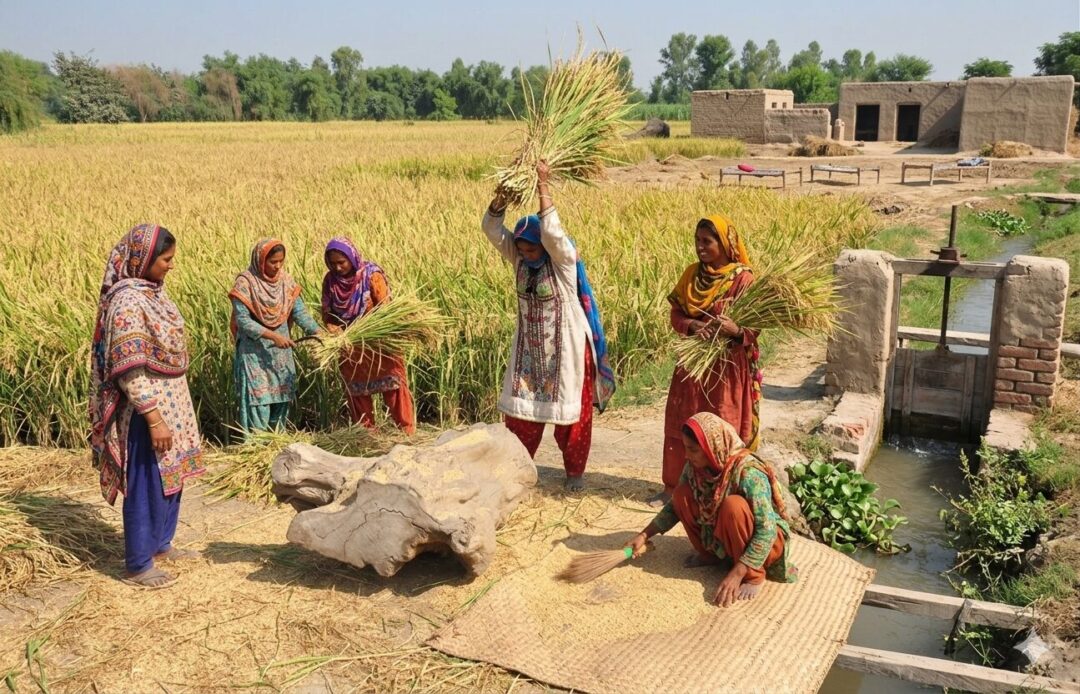
Punjab’s agricultural sector is the backbone of Pakistan’s economy, food security, and rural employment. Within this vast system, millions of women play a silent yet essential role every day. They sow seeds, harvest crops, pick cotton, care for livestock, and contribute to almost every stage of agricultural production.
Despite this contribution, their role has not yet been fully recognized at the legal and policy level. Under current laws in Punjab, women agricultural workers are not formally recognized as “workers.” This represents a fundamental gap, the consequences of which extend beyond individuals and affect the entire system.
It is estimated that more than 8.5 million women in Punjab are engaged in agriculture and livestock-related work. However, none of them are officially registered as workers. When labour is not legally recognized, the rights attached to it also remain ineffective — whether it is minimum wage protection, social security, maternity benefits, workplace safety, or access to formal grievance mechanisms.
This situation is not only a matter of social justice but also a serious governance and policy gap. When the real labour force remains invisible in official systems, development planning, budget allocation, and data-driven policymaking are all compromised.
From an economic perspective as well, the implications are significant. Informal labour systems tend to lack transparency and stability. In contrast, formal recognition and regulation not only strengthen workers’ rights but also improve efficiency, trust, and predictability within the agricultural economy.
Importantly, addressing this gap does not require the creation of entirely new institutions. Punjab already has functioning social security, labour welfare, and related systems. The key requirement is to extend these existing frameworks to include women agricultural workers who are currently excluded.
Sindh provides a clear and relevant example in this regard. In 2019, Sindh passed Pakistan’s first Women Agricultural Workers Act, and its implementation rules were notified in 2026. This demonstrates that the recognition and protection of women agricultural workers is not only possible but can also be implemented effectively within Pakistan’s institutional structure.
This experience also shows that such legislation does not disrupt the agricultural economy. Instead, it helps make it more structured and transparent. Rather than placing an additional burden on small farmers, it creates a more balanced relationship between workers and employers. In particular, reforms in informal systems such as peshgi can contribute to greater stability in rural economies.
For Punjab, this is an important policy moment. This is not only about women’s rights; it is also an opportunity to correct the overall picture of the agricultural economy. As long as millions of women who form the backbone of this system remain unrecognized, the picture of development will remain incomplete.
Recognition, inclusion, and reform — these three elements together can create a legal framework that not only secures the rights of women agricultural workers but also strengthens Punjab’s rural economy in a more organized, transparent, and equitable way.
It is time to ensure that labour is recognized not only in the fields, but also in law.