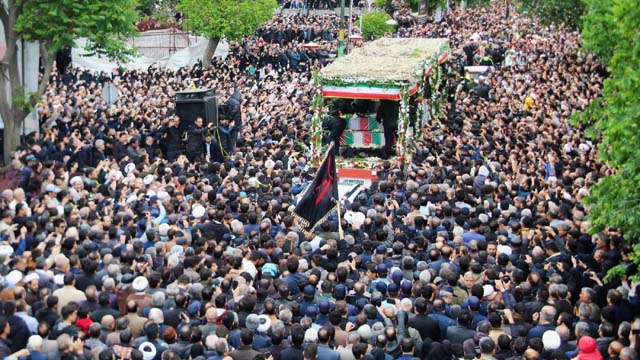
Tens of thousands of Iranians filled the streets of Tehran on Wednesday to join the funeral processions for President Ebrahim Raisi and his entourage, who tragically died in a helicopter crash on Sunday.
The city was awash with mourners holding portraits of Raisi as they converged at the University of Tehran, where Iran’s Supreme Leader Ayatollah Ali Khamenei led prayers for Raisi and his companions, including Foreign Minister Hossein Amir-Abdollahian.
Raisi’s helicopter crashed on a foggy mountainside in northern Iran while en route to Tabriz after attending a dam inauguration near the Azerbaijan border. The accident prompted a massive search and rescue operation with assistance from Turkey, Russia, and the European Union. State television confirmed Raisi’s death early Monday.
The late president, who was 63 and seen as a potential successor to Khamenei, is mourned nationwide. Tehran is adorned with banners honoring Raisi as “the martyr of service” and urging citizens to participate in the funeral. The processions are set to move from the university to Enghelab Square in the city center, with foreign dignitaries in attendance.
Funeral rites commenced on Tuesday in Tabriz and Qom, drawing tens of thousands of black-clad mourners. From Tehran, the bodies will be transported to South Khorasan province and then to Raisi’s hometown of Mashhad, where he will be buried Thursday evening at the Imam Reza shrine.
Supreme Leader Khamenei has declared five days of national mourning and appointed Vice President Mohammad Mokhber as caretaker president until the June 28 election. Ali Bagheri, the top nuclear negotiator and deputy to Amir-Abdollahian, has been named acting foreign minister. An investigation into the crash has been ordered by Iran’s armed forces chief of staff Mohammad Bagheri.
Raisi, elected in 2021, succeeded the moderate Hassan Rouhani amid severe economic challenges due to US sanctions. His presidency witnessed significant protests, economic turmoil, and heightened tensions with Israel. Condolences have poured in globally from allies like Russia and China, and regional partners such as Syria, Hamas, and Hezbollah, with NATO and the UN Security Council also expressing their sympathies.