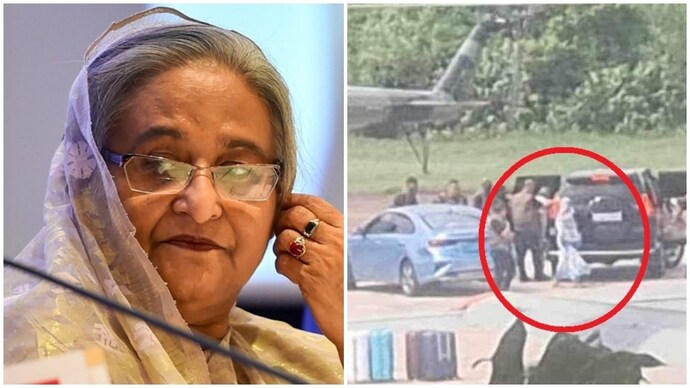
Bangladesh’s army chief Wakeruz Zaman said on Monday that Prime Minister Sheikh Hasina has resigned and an interim government would run the country — the culmination of more than a month of deadly anti-government protests.
Since late July, Bangladesh has been engulfed by protests and violence that has so far claimed the lives of at least 300 people, according to an AFP tally based on police, government officials and doctors at hospitals.
Protesting student groups have demanded the scrapping of a controversial quota system in government jobs, which escalated into a campaign to seek the ouster of Hasina, who won a fourth straight term in January in an election boycotted by the opposition.
Earlier today, students in Bangladesh called for a march to Dhaka in defiance of a nationwide curfew, a day after deadly clashes in the country killed at least 91 people.
Jubilant-looking crowds waved flags, peacefully celebrating including some dancing on top of a tank, as a source close to the embattled leader said she had left her palace in the capital for a “safer place”.
According to multiple media outlets, including the BBC and Reuters, Hasina has fled to India. After she fled, cheering protesters stormed her palace — the culmination of more than a month of deadly anti-government protests.
Hasina’s son urged the country’s security forces to block any takeover from her rule, while a senior advisor told AFP that her resignation was a “possibility” after being questioned as to whether she would quit.
“She wanted to record a speech, but she could not get an opportunity to do that,” the source close to Hasina told AFP.
The army chief told officers on Saturday that the military “always stood by the people”, according to an official statement.
The military declared an emergency in January 2007 after widespread political unrest and installed a military-backed caretaker government for two years.
Internet access was tightly restricted on Monday, offices were closed and more than 3,500 factories servicing Bangladesh’s economically vital garment industry were shut.
Soldiers and police with armoured vehicles in Dhaka had barricaded routes to Hasina’s office with barbed wire, AFP reporters said, but vast crowds flooded the streets, tearing down barriers.
The Business Standard newspaper estimated as many as 400,000 protesters were on the streets but it was impossible to verify the figure.
“The time has come for the final protest,” said Asif Mahmud, one of the key leaders in the nationwide civil disobedience campaign.
Protesting students in Bangladesh have called for a march to Dhaka in defiance of a nationwide curfew to press Hasina to resign.
Army tanks and police vehicles were on the streets of the capital on Monday, with security forces patrolling on foot, an online news channel showed. There was almost no civilian traffic, barring a few motorcycles and three-wheel taxis.
At least 91 people were killed and hundreds injured on Sunday in a wave of violence across the country of 170 million people as police fired tear gas and rubber bullets to disperse tens of thousands of protesters.