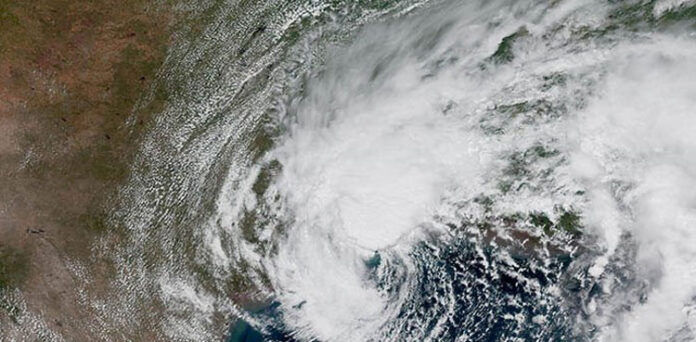
The Pakistan Meteorology Department (PMD) announced on Friday that a deep depression, currently 200 kilometers southeast of Karachi, is gradually moving toward the Arabian Sea from India’s Rann of Kutch. This deep depression, described as a very strong low-pressure area, is expected to continue its west-southwestward trajectory along Sindh’s coastal belt.
According to the PMD’s latest cyclone alert, this low-pressure system may intensify into a cyclonic storm by this afternoon or evening, provided that environmental conditions remain favorable.
The Met Office has also issued a forecast for heavy rainfall in Karachi within the next 24 hours, accompanied by strong winds and thundershowers. On Friday, the minimum temperature in Karachi was recorded at 26°C, with the maximum expected to range between 28°C to 30°C. Winds in the city are currently blowing from the northeast at a speed of 22 km/hour.
The potential cyclonic storm is likely to impact various regions of Sindh, including Karachi division, Tharparkar, Badin, Thatta, Sujawal, Hyderabad, Tandu Muhammad Khan, Tandu Allah Yar, Matiari, Umerkot, Mirpurkhas, Sanghar, Jamshoro, Dadu, and Shaheed Benazirabad districts. These areas may experience heavy rainfall until August 31.
Additionally, parts of Balochistan, including Hub, Lasbella, Awaran, Kech, and Gwadar districts, are also expected to receive heavy downpours between August 30 and September 1, with occasional breaks. The PMD has warned that heavy rains may lead to waterlogging or rain inundation in low-lying areas along the Sindh-Makran coast. Sea conditions are expected to remain rough, with squally winds prevailing.
In light of these developments, the PMD has advised fishermen in Sindh and Balochistan to avoid venturing into the sea until September 1. Residents are also urged to avoid unnecessary movement during this period.
Rainfall in Karachi Over the Past 24 Hours
Several areas of Karachi experienced significant rainfall on Thursday, which intensified into a heavy downpour later in the night. According to the meteorological department, Sarjani Town recorded the highest rainfall, measuring 127.6 millimeters. In contrast, DHA Phase II recorded the lowest rainfall at 10.7 millimeters.
- Sarjani Town: 127.6mm (highest)
- Gulshan-e-Hadid: 46mm
- Nazimabad: 45.2mm
- Kemari: 42mm
- PAF Faisal Base: 38mm
- Korangi: 36.3mm
- North Karachi: 32.9mm
- University Road: 32.8mm
- Quaidabad: 29.5mm
- Old Airport: 29.4mm
- Gulshan-e-Maymar: 26mm
- PAF Masroor Base: 25.5mm
- Jinnah Terminal: 25.4mm
- Orangi: 18.8mm
- Gadap: 12.1mm
- DHA Phase II: 10.7mm (lowest)