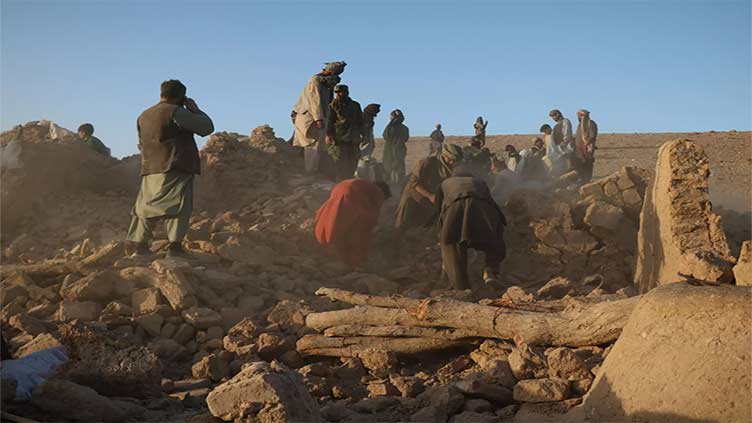
Northwestern Afghanistan experienced a 6.3 magnitude earthquake, as reported by the German Research Center for Geosciences (GFZ). The earthquake occurred at a depth of 10 kilometers and followed a series of recent seismic events in the region. The epicenter was situated approximately 29 kilometers north of Herat province, according to the United States Geological Survey.
While details on casualties from this latest earthquake were not immediately available, rescue teams and volunteers have been actively working to locate survivors in the aftermath of previous quakes. These earlier tremors had devastating effects, including the destruction of entire villages and impacting around 12,000 people, as estimated by the United Nations (UN). The disaster ministry reported 2,053 casualties, although precise numbers remain fluid.
The most recent earthquake hit near Herat city, which is home to over half a million people. Previous earthquakes completely destroyed at least 11 villages in Herat province’s Zenda Jan district. Many Herat residents had been living in tents in the open air due to the fear of aftershocks following the weekend tremors.
Providing shelter on a large scale poses a challenge for Afghanistan’s Taliban authorities, who assumed power in August 2021 and have complex relations with international aid organizations. Afghanistan frequently experiences deadly earthquakes, with the recent disaster being the most severe in over 25 years.
The majority of rural Afghan homes are constructed from mud and wood, offering limited structural reinforcement, which leaves communities vulnerable to significant earthquakes. In addition to the earthquake’s impact, Afghanistan is grappling with a dire humanitarian crisis due to the widespread withdrawal of foreign aid. The Herat province, bordering Iran and home to around 1.9 million people, has been further strained by years of drought affecting its rural communities.