In what many perceive as an admission of guilt by Imran Khan, the government’s efforts to ban the opposition PTI from the political mainstream are intensifying.
Recently, media reports revealed that the PTI founder, while speaking to journalists at Adiala jail, acknowledged calling for a protest outside the GHQ if he was arrested. Although the party and his legal team insist it was a call for a “peaceful protest,” PTI’s opponents have seized upon the statement, seeing it as validation of their concerns about the party.
Responding to the ‘admission,’ Information Minister Atta Tarar announced that the government had decided, in principle, to ban the PTI. “We have principally decided to ban PTI, but are waiting for a broader consensus among ruling allies to impose the ban,” he said during an appearance on a private news channel.
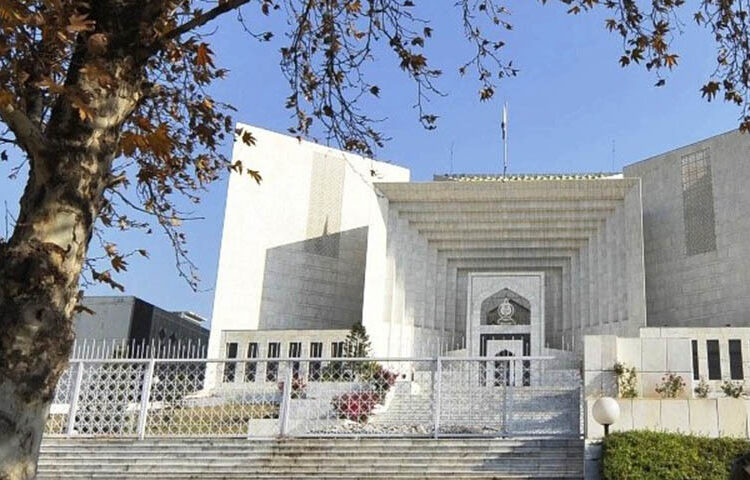
Previously, the government had stated that consultations were ongoing among ruling allies regarding the decision to ban the opposition party. However, the PPP has now also been persuaded, filing a petition with the Supreme Court to challenge the July 12 verdict that awarded reserved seats to the PTI and recognized it as a parliamentary party.
The PPP’s review petition, filed by senior counsel Farooq H. Naek, objects to the SC’s interpretation of Article 51(d)(e) and Article 106, which asserted that the PTI “was and is” a political party that secured or won general seats in the national and provincial assemblies in the February 8 general election.
This marks the third such petition, following one by the PML-N on July 15, which contended that the full bench had overstepped its bounds by legislating rather than interpreting the Constitution. Additionally, three PML-N women members elected on reserved seats have filed review petitions.
The PPP reiterated that the PTI did not file any case before the ECP, Peshawar High Court (PHC), or the Supreme Court, and thus, it is not entitled to any relief, particularly relief that was not even requested. The petition also argued that 80 MNAs had filed their nomination papers as independent candidates and later joined the SIC as independents. The short order under review wrongly assumed that these MNAs were PTI candidates.
According to the July 12 short order, 41 returned candidates were given a 15-day period to join any political party despite not showing affiliation with the PTI in the ECP list. This procedure contradicts the Constitution, the Elections Act, 2017, and established jurisprudence, the petition asserted.
The petition further argued that the short order violated Rule 92 (6) of the Election Rules, 2017, which states that once an independent candidate joins a political party, there is no option to recall or cancel it. The petition claimed that by creating a new procedure not provided under the Constitution, the short order overstepped into creating rather than interpreting the Constitution, contrary to SC jurisprudence.
The submission of the review petition by the PPP surprised many, as just days prior, the party had advised the PML-N to reconsider its decision to seek a review, believing the government would not obtain relief.
A senior PPP leader, speaking on condition of anonymity, revealed that internal opinions were divided over filing the petition. The top brass allowed Mr. Naek to proceed after a formal request from the PML-N, which wanted the PPP to join the case as part of the ruling coalition. The move was seen as necessary to uphold parliamentary supremacy and signal other institutions to respect constitutional boundaries.
Despite earlier opposition to filing the petition, the PPP assured the PML-N of their support if it decided to proceed. PML-N leaders, not expecting a favorable decision from the Supreme Court, indicated that their aim was to formally record their stance.