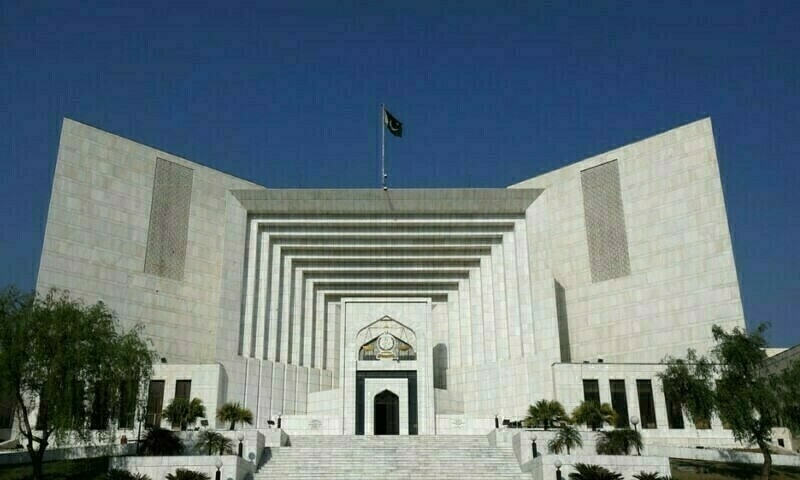
During a hearing at the Supreme Court of Pakistan, Justice Ijaz Ul Ahsan expressed his concerns about the Supreme Court (Practice and Procedure) Act 2023, suggesting that it interferes with the independence of the judiciary.
The hearing pertains to petitions challenging the law’s impact on the discretionary powers of the country’s chief judge. The full-court bench, led by Chief Justice of Pakistan Qazi Faez Isa and comprising all 15 judges of the Supreme Court, heard the case, which was broadcast live on state-run PTV.
The proceedings began with arguments presented by the lawyer for the Muttahida Qaumi Movement-Pakistan (MQM-P), Faisal Siddiqi. He based his arguments on two cases, the Baz Kakar case and the Supreme Court’s verdict on the Supreme Court (Review of Judgements and Orders) Act 2023. Siddiqi also addressed questions regarding the definition of “law” in Article 191 of the Constitution.
Justice Ahsan’s interruption of the lawyer’s argument led to an exchange of words with Chief Justice Isa, who urged the bench members to allow the lawyer to complete his arguments without interruptions.
Justice Ahsan questioned the interference in the Supreme Court’s independence caused by the law in question. Siddiqi argued that parliament could not enact laws that restrict the Supreme Court from making its own rules, emphasizing that parliament could only supervise the judiciary within certain limits.
The discussion also delved into the possibility of extending the Supreme Court’s jurisdiction, with Justice Minallah noting that the only limitation on the court’s jurisdiction related to “entry 55.” Justice Shah inquired about the constitutional provisions that allowed for expanding the scope of Article 184(3) of the Constitution.
Siddiqi cited a Lahore High Court (LHC) verdict to support his argument that parliament could legislate to increase the top court’s jurisdiction. However, the question arose as to whether the LHC’s verdict on jurisdiction had been challenged in the Supreme Court, to which the lawyer responded that the matter was pending.
The issue of the right to appeal under the Constitution was also discussed, with Justice Ahsan emphasizing that the right to appeal could not be conferred by sub-constitutional legislation. The lawyer suggested that the court should examine whether intra-court appeals within the Supreme Court were possible.
Justice Malik raised questions about the principle of separation of powers, particularly when the Supreme Court intervenes in parliamentary matters. The bench discussed the Supreme Court’s authority to make its own rules and the Constitution’s use of the phrase “subject to the Constitution and law.”
As the MQM-P counsel concluded his arguments, the hearing continued with the adoption of arguments in favor of the law presented by Pakistan Bar Council (PBC) lawyer Haroon-ur-Rashid. Chief Justice Isa directed the Attorney General for Pakistan to continue presenting his arguments in the next hearing, scheduled for Wednesday at 11:30 am.