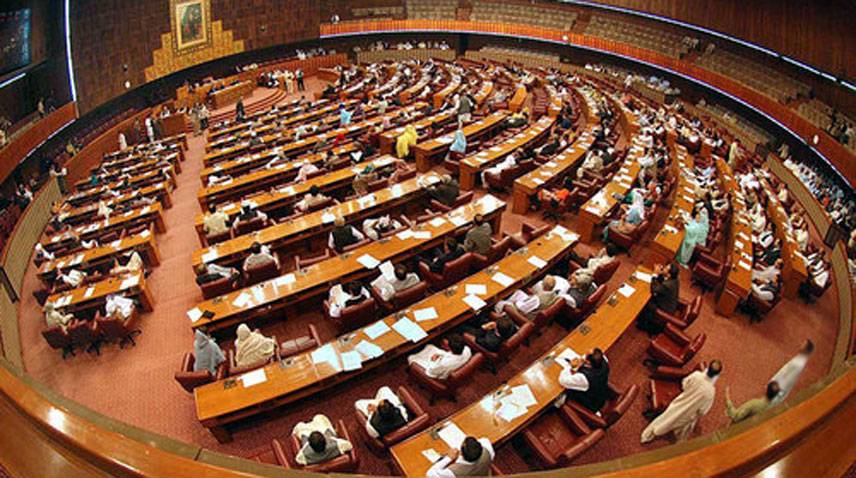
The National Assembly on Tuesday passed a bill aimed at barring independent lawmakers from joining a party after a stipulated period, with the opposition PTI voicing strong protest against it.
The bill, titled “Elections (Second Amendment) Act, 2024,” introduces amendments to the Elections Act 2017. Political observers view this move as an attempt to counter the Supreme Court’s July 12 ruling, which declared the PTI eligible for reserved seats and set it to re-emerge as the largest party in the National Assembly.
PML-N lawmaker Bilal Azhar Kayani introduced the legislation in the National Assembly a week ago. It was swiftly pushed through the lower house’s Standing Committee on Parliamentary Affairs, passing with an 8-4 vote. The bill states that if a candidate does not file a declaration before the returning officer about their affiliation with a political party, they will be considered an independent candidate.
Law Minister Azam Nazeer Tarar briefed the committee, claiming the bill would remove confusion, prompting surprise from PTI’s Ali Muhammad at the minister’s defense of a private member bill. Shahida Akhtar of Jamiat Ulema-i-Islam (Fazl) commented that such legislation would weaken the parliament.
The bill now awaits approval in the Senate before becoming law. It also stipulates that an independent candidate shall not be considered a candidate of any party if they declare their independence at a later stage. Another amendment proposes that a political party should not be allocated reserved seats for women and non-Muslims if it fails to submit its list within the prescribed time.
Interestingly, amendments to sections 66 and 104 of the Elections Act include a declaration that the proposed amendments would take precedence over court orders. Speaking on the floor of the National Assembly, PTI’s Ali Muhammad Khan argued that the bill would deprive him of his rights. Gohar Ali Khan also lamented its consequences for his party.
Ali Muhammad questioned whether Parliament could be used by a political party to attack the Supreme Court for political gains. He stated that his party could not be convicted for past actions even if the government proceeds with this legislation.
“If my party is being granted a right through a Supreme Court order, how can you make a new law and deny us that right?” he asked. He declared that PTI would protest and reject the bill, calling it an attack on the Supreme Court by the government through Parliament.
Outside the Parliament, Bilal Azhar Kayani expressed hope that the Senate would also pass the bill. He stated that the legislation “further clarified and strengthened” existing laws, detailing three main changes to the Elections Act. Kayani asserted that no one could point out any conflict with the Constitution in the bill. He disagreed with the majority judgment in the case of reserved seats, arguing that the PTI was not even a party in the case, and the Sunni Ittehad Council, the petitioner, was not given any relief.
The Supreme Court of Pakistan on July 12 declared the PTI eligible for seats reserved for women and minorities, delivering a significant setback to Prime Minister Shehbaz Sharif’s ruling coalition.
The verdict followed appeals by the Sunni Ittehad Council against the denial of reserved seats by the Peshawar High Court and the Election Commission of Pakistan. PTI-backed candidates, who had contested and won the February 8 elections as independents, had joined the Sunni Ittehad Council to form a coalition.
The Supreme Court annulled the decision of the Peshawar High Court and declared the election regulator’s decision null and void, deeming it unconstitutional.
4o