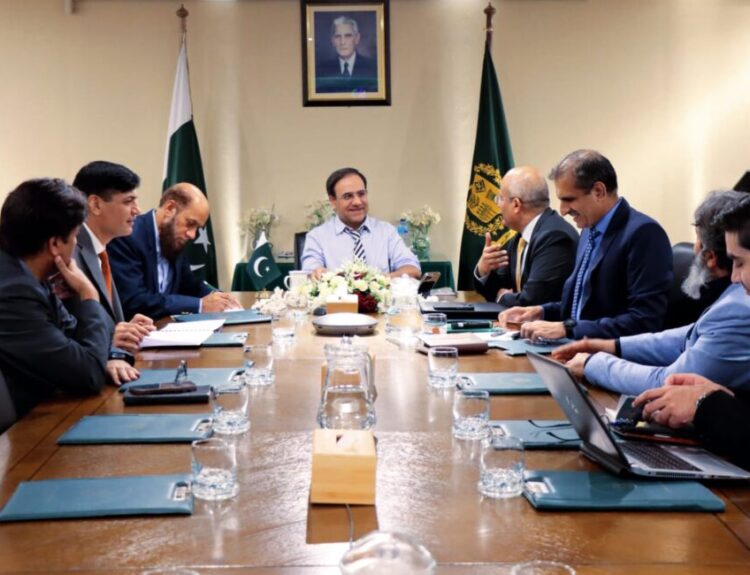
The National Center for Physics (NCP) at Quaid-i-Azam University, Islamabad, hosted the inaugural session of the First International Conference on 3D Printing and Vacuum Technology. The three-day event, held from October 23 to 25, 2024, brings together over 50 leading researchers and scientists from around the world to discuss the latest advancements in these groundbreaking technologies.
Federal Minister for Planning, Development, and Special Initiatives, Professor Ahsan Iqbal, delivered the keynote address, emphasizing the critical role of science and technology in Pakistan’s development. He urged researchers, scientists, and innovators to contribute towards making Pakistan a global leader in technological progress.
Minister Iqbal highlighted the potential of 3D printing and vacuum technology to revolutionize various industries, including healthcare, aerospace, construction, and energy. “We stand at the intersection of two transformative innovations—3D printing and vacuum technology—that are reshaping production, manufacturing, and research on a global scale,” he stated.
Citing international examples, the Minister referred to 3D printing in healthcare, where bioprinting is advancing the creation of living tissues and custom implants. He also pointed to NASA’s use of 3D printing to manufacture rocket components, reducing costs and expanding space exploration opportunities. Minister Iqbal further cited Dubai’s initiative to construct 25% of its new buildings with 3D printing technology by 2030, and China’s large-scale adoption of the technology to construct entire neighborhoods.
Outlining the government’s vision, Minister Iqbal discussed Pakistan’s plan to harness these innovations under the “5Es Development Framework,” aimed at transforming the country into a trillion-dollar economy by 2035. He underscored the role of 3D printing in boosting exports, driving digital transformation through the E-Pakistan initiative, fostering environmentally sustainable manufacturing, and enhancing energy efficiency. He added that these technologies can potentially empower marginalized communities by providing accessible, affordable solutions.
The Minister reaffirmed the government’s commitment to fostering innovation through initiatives such as the Pakistan Innovation Fund and Centers of Excellence. He stressed the importance of collaboration between the government, private sector, academia, and research institutions in preparing Pakistan’s youth for leadership roles in emerging technologies.
The conference will serve as a platform for participants to share knowledge, collaborate, and explore the latest applications of 3D printing and vacuum technology across various industries.