The Supreme Court of Pakistan is set to revisit the Faizabad sit-in case on September 28th in response to a series of review petitions submitted against its previous ruling. The three-member panel, led by Chief Justice Qazi Faez Isa and consisting of Justices Amin-ud-Din Khan and Athar Minallah, will hear the review proceedings.
This legal saga began on April 15, 2019, when the then-federal government, along with various entities including the Defence Ministry, Intelligence Bureau, Pakistan Tehreek-e-Insaaf (PTI) government, Awami Muslim League (AML) chief Sheikh Rashid Ahmed, Mutahidda Qaumi Movement (MQM), and the Pakistan Electronic Media Regulatory Authority (Pemra), filed review pleas challenging the apex court’s judgment delivered by the current Chief Justice Qazi Faez Isa regarding the Faizabad sit-in case.
Earlier, on February 6, 2019, a two-member bench of the apex court comprising the now-CJP Isa and Justice Mushir Alam recommended that those issuing an edict or fatwa to harm another person or put them in harm’s way must be dealt with severely and prosecuted under relevant laws. The bench also ruled that intelligence agencies must not exceed their respective mandates. Subsequently, the bench disposed of a suo moto case related to the 2017 Faizabad sit-in staged by the Tehreek-e-Labbaik Pakistan (TLP).
The verdict issued by the two-judge bench emphasized that every citizen and political party has the right to assemble and protest as long as the assembly and protest are peaceful and comply with the law. It also stated that this right is subject to reasonable restrictions in the interest of public order and should not infringe on the fundamental rights of others, including their right to free movement and property.
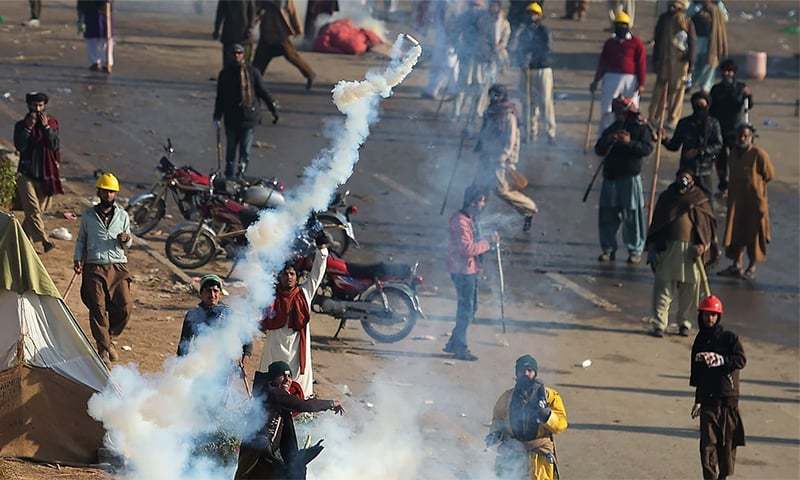
In November 2017, the Supreme Court took suo motu notice of the three-week-long sit-in, which was held in protest against a change in the finality-of-Prophethood oath when the government passed the Elections Act 2017. The sit-in was concluded after an agreement was reached between the protesters and the government.