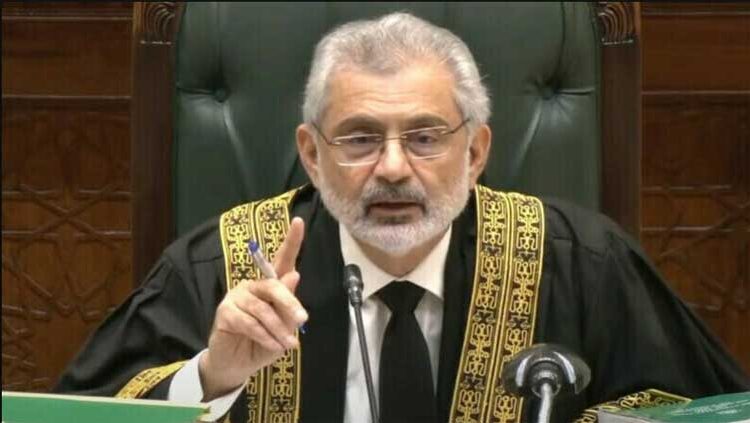
In a recent hearing, Chief Justice of Pakistan (CJP) Qazi Faez Isa commented on the Supreme Court (Practice and Procedure) Act 2023, which seeks to regulate the discretionary powers of the country’s top judge. The hearing focused on the limitations imposed on suo moto powers and the right to appeal. Here are the key highlights from the hearing:
CJP Isa acknowledged that Parliament passed the Supreme Court (Practice and Procedure) Act 2023 with “good intentions.”
During the hearing, the CJP expressed displeasure when a petitioner cited a US court’s verdict as a precedent to challenge the amendments in the SC law. He questioned whether Parliament could correct a mistake made by the Chief Justice.
Lawyers presented arguments related to the Parliament’s powers to make SC rules by act and the impact of the law on the Chief Justice’s office.
The lawyer representing a petitioner argued that the Constitution deliberately did not grant Parliament the power to alter the rules of the Supreme Court. He highlighted that the SC law makes the Chief Justice’s office redundant.
The discussion also revolved around the right to appeal and whether the Parliament could expand the Supreme Court’s jurisdiction through legislation.
CJP Isa emphasized that he is a “slave of the Constitution” and expressed concerns about the potential consequences of granting Parliament significant powers over the judiciary.
The case background involves the Supreme Court (Practice and Procedure) Act 2023, which aims to limit the suo moto powers of the Chief Justice and introduces the right to appeal in suo moto cases.
The Act also addresses the constitution of benches, original jurisdiction, and appeals related to matters invoking Article 184(3) of the Constitution.
The hearing explored the relationship between the judiciary and Parliament, focusing on the extent of Parliament’s authority in matters concerning the judiciary.
The case continues to be of significant interest as it raises fundamental questions about the separation of powers and the role of the judiciary in Pakistan’s legal framework.