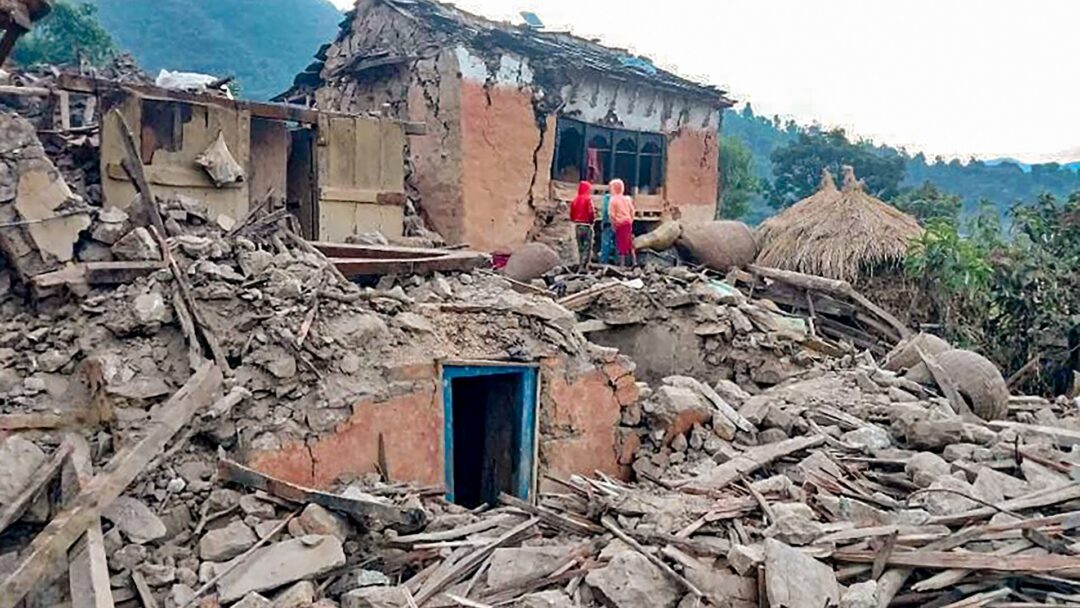
A devastating 6.8 magnitude earthquake struck the northern foothills of the Himalayas near one of Tibet’s holiest cities on Tuesday, leaving at least 53 people dead and 62 injured, according to Chinese authorities. The powerful quake also caused tremors across Nepal, Bhutan, and northern India, shaking buildings and prompting evacuations in affected areas.
The earthquake hit at 9:05 am local time (8:20 am PST), with its epicenter in Tingri, a rural county in China often referred to as the northern gateway to the Everest region. The China Earthquake Networks Centre reported the quake’s depth at 10 kilometers. Meanwhile, the US Geological Service measured the quake’s magnitude at 7.1.
In Tibet, the Chinese state-run news agency Xinhua reported significant casualties and damage, with Tingri bearing the brunt of the impact. Villages in the vicinity experienced strong shaking, followed by dozens of aftershocks with magnitudes as high as 4.4. Videos on social media depicted crumbled shopfronts and debris-laden roads in Lhatse, a nearby town.
The tremors extended far beyond the epicenter. Nepal’s National Disaster Risk Reduction and Management Authority (NDRRMA) confirmed the earthquake was felt in seven hill districts bordering Tibet. However, no immediate reports of casualties or property damage were received from Nepal. Spokesman Dizan Bhattarai stated that police, security forces, and local authorities had been mobilized to gather information, particularly from the sparsely populated and remote villages accessible only by foot.
Residents of Nepal’s capital, Kathmandu, located 400 kilometers away, felt the tremors and rushed out of their homes in panic. In Bhutan’s capital Thimphu and India’s northern state of Bihar, tremors were also reported, though Indian officials confirmed no damage or loss of life.
The Shigatse region of Tibet, home to 800,000 people, was heavily affected. The region is historically significant as the traditional seat of the Panchen Lama, an important figure in Tibetan Buddhism. According to Xinhua, three townships and 27 villages within a 20-kilometer radius of the epicenter house approximately 6,900 residents. Local authorities are working to assess the damage and casualties.
Chinese President Xi Jinping called for an all-out search and rescue operation, emphasizing the need to minimize casualties, provide adequate winter shelter for those affected, and ensure a safe recovery process.
The earthquake comes as a stark reminder of the region’s seismic vulnerability due to the collision of the Indian and Eurasian tectonic plates. In 2015, a magnitude 7.8 earthquake struck near Kathmandu, Nepal, killing nearly 9,000 people and causing widespread destruction.
Tuesday’s quake occurred about 80 kilometers north of Mount Everest, the world’s tallest peak and a popular destination for climbers and trekkers. Winter is typically an off-season for expeditions, with only one German climber having obtained a permit to scale the mountain this season. According to Lilathar Awasthi, a Nepalese tourism official, the climber had already left the Everest base camp after an unsuccessful summit attempt.
The region remains on high alert as aftershocks continue to rattle affected areas, and relief efforts are underway to assess and address the full extent of the devastation.