

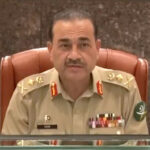
Gallup survey news: In a recent Gallup survey conducted across Pakistan, the Pakistan Army has emerged as the institution with the highest level of public approval, earning an impressive 88 percent rating.
The survey, titled “National Public Opinion Poll Report,” conducted between June 10 and June 30, gathered responses from 3,500 participants representing various regions in all four provinces of Pakistan.
The survey illuminated the public’s sentiments on various institutions and political figures, offering a comprehensive snapshot of Pakistan’s current political landscape and the challenges it faces, including inflation, poverty, unemployment, and concerns about the efficacy of democracy.
The results of the survey showcased the public’s perception of various institutions, with both the media and the courts receiving a 56 percent approval rating, while the Election Commission of Pakistan (ECP) garnered a 42 percent approval rating.
The police earned a 54 percent approval rating, while politicians secured the lowest rating on the list, with only 39 percent of respondents approving of their performance.
Region-wise breakdowns revealed Khyber-Pakhtunkhwa (K-P) leading the approval ratings for the army with an impressive 91 percent, closely followed by Punjab at 90 percent. Sindh recorded an 88 percent approval rating for the army, while Balochistan showed the lowest approval at 66 percent. Remarkably, 57 percent of respondents strongly approved of the army’s performance.
In terms of political leadership, Pakistan Tehreek-e-Insaf (PTI) Chairman Imran Khan maintained his position as the country’s most popular leader, earning over a 60 percent approval rating. Saad Rizvi, the chief of Tehreek-e-Labbaik Pakistan (TLP), secured a distant second place with a 38 percent approval rating, sharing this rating with PTI President Parvez Elahi.
Other notable ratings included PTI’s Shah Mahmood Qureshi at 37 percent, followed closely by Pakistan Muslim League-Nawaz (PML-N) supreme leader Nawaz Sharif at 36 percent, PML-N President Shehbaz Sharif at 35 percent, PML-N Senior Vice President Maryam Nawaz at 30 percent, and PML-N’s Shahid Khaqan Abbasi at 28 percent.
When it came to political party preferences, PTI led with a 59 percent likability rating, with Pakistan Peoples Party (PPP) following at 42 percent, TLP at 41 percent, PML-N at 38 percent, and Jamaat-e-Islami (JI) at 31 percent. On the other hand, Jamiat-e-Ulema Islam-Fazl (JUI-F) received a 22 percent approval rating, while Pakistan Muslim League-Quaid (PML-Q), Awami National Party (ANP), and Muttahida Qaumi Movement-Pakistan (MQM-P) garnered 22 percent, 21 percent, and 20 percent approval ratings, respectively.
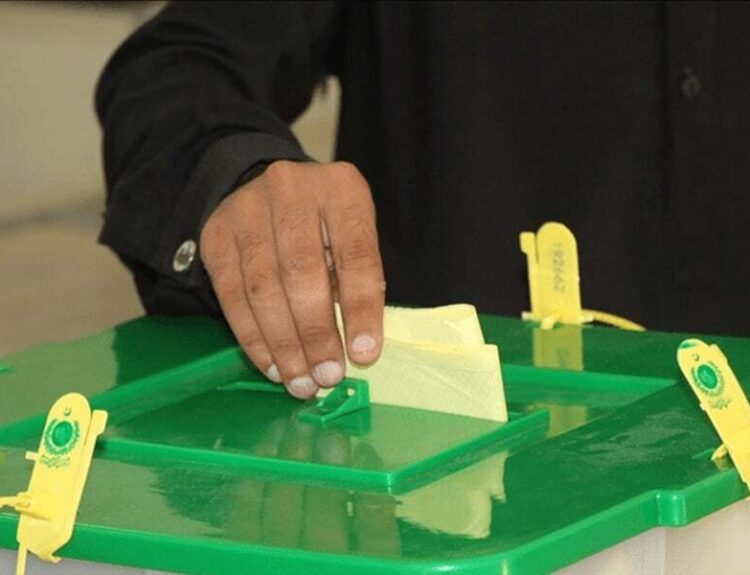
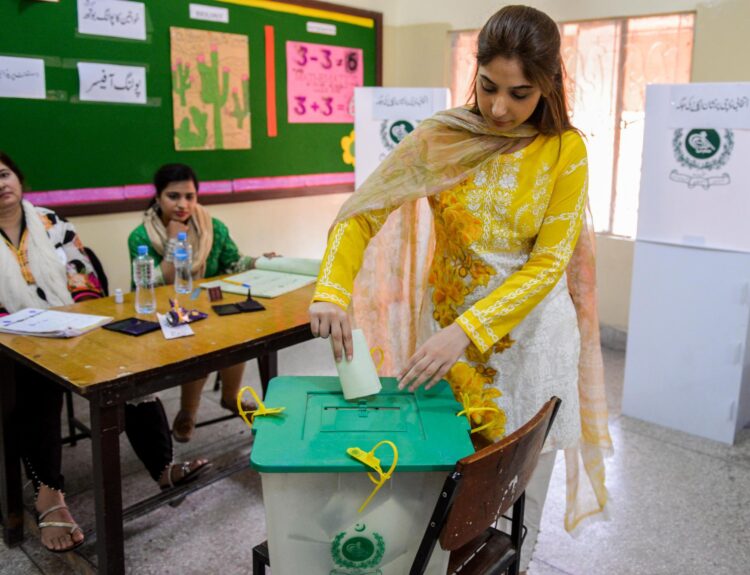
The survey also explored voting preferences, revealing that twice as many respondents would vote for PTI if elections were held next week compared to those who would vote for PML-N. In terms of governance indicators, the PTI government received the highest rating for its economic performance.
However, the survey also highlighted public dissatisfaction, with 77 percent of respondents reporting dissatisfaction with the country’s current direction, while 47 percent described the economic situation as “very bad.” Only 15 percent of respondents believed that the country’s economic situation would improve significantly over the next 12 months.
According to the report, inflation, poverty, and unemployment remained the most serious problems in Pakistan, with one in five people (20 percent) feeling that democracy is not delivering at all.

12 Comments