Pakistan grapples with a significant challenge – water scarcity,
impacting crucial sectors like agriculture, food security, and societal well-being.
In response to this pressing issue, the CGIAR’s NEXUS Gains Initiative, spearheaded by the International Water
Management Institute (IWMI) and the International Food Policy Research Institute (IFPRI), is
implementing a comprehensive strategy.
This initiative aims to address low water productivity and advance the Sustainable Development Goals (SDGs) by transforming the food, land, and water systems in the Indus Basin.
A crucial aspect of this initiative is the Environmental Flow (E-Flow) assessment of the Indus
River basin, a pivotal vital step toward sustainable water management. Recognizing the pressing
need for accurate data and informed decision-making, the International Water Management
Institute (IWMI) and the Pakistan Council of Research in Water Resources (PCRWR) teams are set
to apply an environmental flow model in the Indus Basin. This model aims to understand the
environmental water needs for various river reaches across the eastern and western rivers in the
basin.
“Despite proactive measures, the focus on E-Flow in Pakistan remains insufficient, exacerbated
by the absence of a dedicated department and a systematic approach to acquiring data for EFlow assessment and management in the Indus Basin.” Said by Dr. Mohsin Hafeez, Director,
Water, Food & Ecosystems, IWMI.
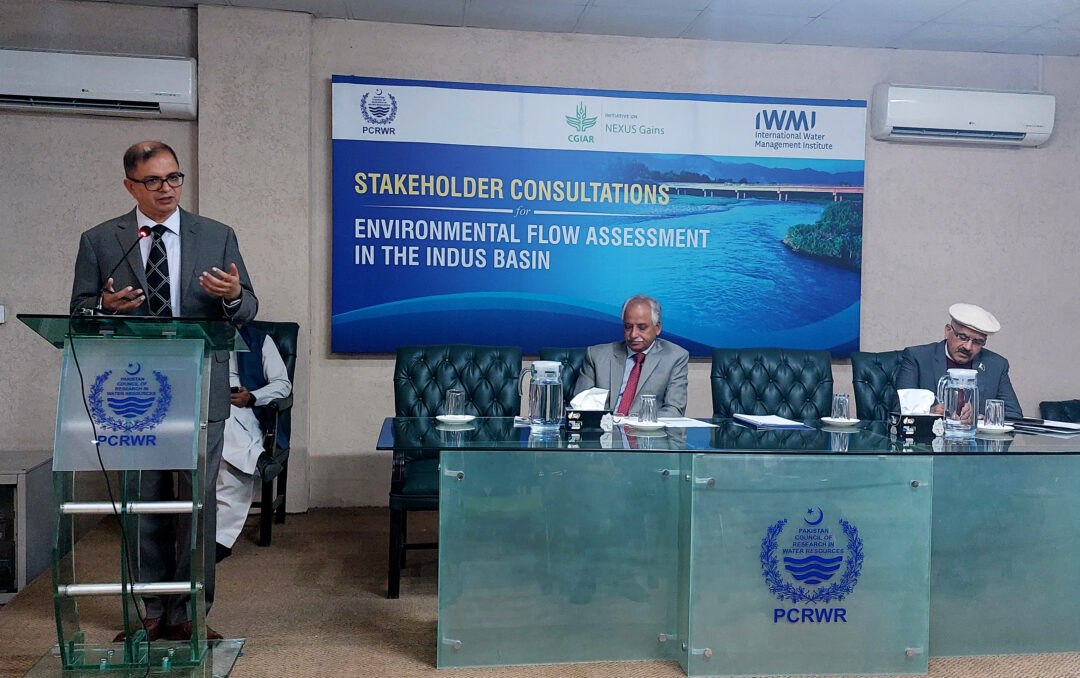
In response to this gap, IWMI and PCRWR have initiated a series of stakeholder consultations at
national and provincial levels. “Our objective is clear – gather firsthand information and insights
from key professionals, planners, and policymakers in the water and related sectors. This
consultation aims to address critical questions for effective E-Flow assessment and management
in Pakistan, including understanding E-Flow requirements, identifying available datasets,
evaluating existing policies, establishing prioritization at federal and provincial levels, and
fostering collaboration on ongoing and planned projects.” Dr. Mohsin Hafeez further added.
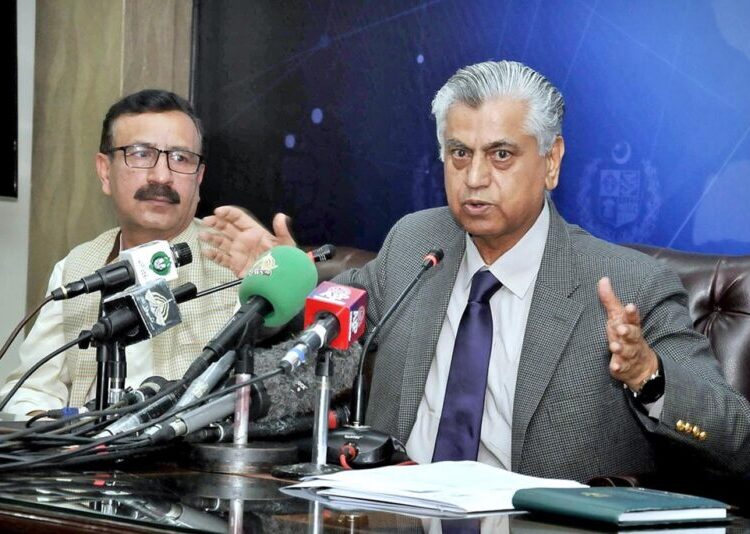
The consultation also included interactive discussions which led by Dr. Muhammad Ashraf,
Chairman of Pakistan Council of Research in Water Resources (PCRWR). The panel discussion
focused on having a unified approach towards sustainable water management.
The stakeholders anticipated several outcomes from this consultation, including increased
comprehension and awareness of E-Flow requisites, identification of available datasets,
prioritization at federal and provincial levels, exchange of information on ongoing and planned
projects, and investigation into necessary steps within the Water-Energy-Food-Climate Nexus to
address E-Flow issues.
This collaborative effort aims to strengthen decision-making, promote collaboration, and
establish a unified approach to effectively assess and manage E-Flow in Pakistan.