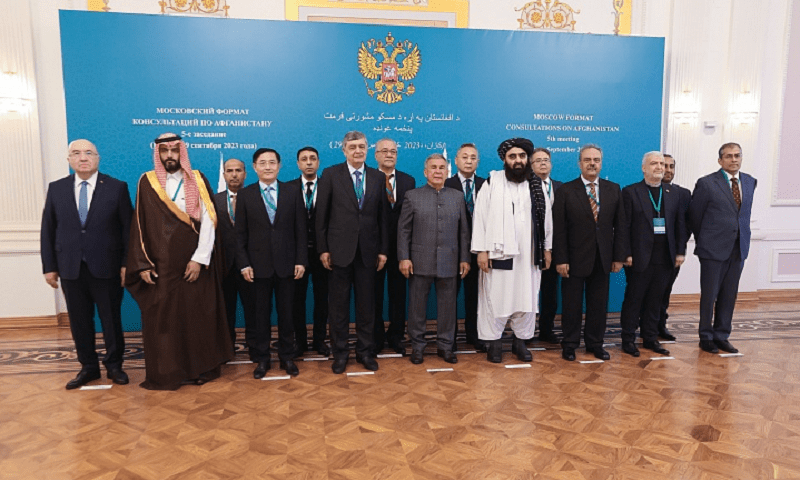
During the fifth Moscow Format Consultations on Afghanistan held in Kazan, Russia, a regional security meeting involving high-ranking officials from Pakistan, China, India, Iran, Kazakhstan, Kyrgyzstan, Russia, Turkmenistan, and Uzbekistan, along with representatives from Saudi Arabia, Qatar, the United Arab Emirates, and Turkiye as guests of honor, called upon the interim Afghan government to take effective measures to “dismantle” all terrorist groups operating within Afghanistan. The meeting aimed to address the challenging security situation in Afghanistan and its regional implications.
The attendees expressed deep concern about the intensified activities of terrorist groups, particularly ISIS, in Afghanistan. They urged the Afghan authorities to take action to “dismantle, eliminate, and prevent the placement of all sorts of terrorist groups” within the country. The participants emphasized the importance of preventing Afghanistan from becoming a hotspot for terrorism and instability that could spread to neighboring states.
Additionally, the meeting highlighted the need for Afghanistan to continue its “real and effective anti-drug policy,” including efforts to combat industrial drug production, which has seen a concerning increase.
The participants called on the Afghan authorities to strengthen collaboration with regional nations to address challenges related to terrorism and drug trafficking originating from Afghan soil. They voiced their opposition to external support for terrorism in Afghanistan.
The meeting noted the absence of progress in forming an inclusive government in Afghanistan that represents the interests of all ethno-political groups. While some individuals from diverse Afghan ethnic backgrounds have been appointed to positions within the Kabul administration, the meeting stressed the need for greater political pluralism. It urged the Afghan authorities to engage in a “practical, outcome-oriented dialogue” with representatives of alternative ethno-political groups to establish a more inclusive and accountable government.
Furthermore, the participants called for improved welfare conditions for the Afghan people, the prevention of further migration, and the facilitation of refugee return. They emphasized the promotion of fundamental rights and freedoms, equal access to employment, education, and justice for all individuals, regardless of gender, ethnicity, or religion. The meeting expressed concerns about restrictions on women’s employment and girls’ education and called on the Afghan authorities to support modern education conforming to international standards.
The participants reaffirmed their support for an independent, united, and peaceful Afghanistan, rejecting the deployment of military infrastructure facilities of third countries in Afghanistan and neighboring states.
They recognized the potential for regional economic projects involving Afghanistan and stressed the need to strengthen economic ties through bilateral and multilateral initiatives.
Additionally, the meeting highlighted the importance of humanitarian assistance to Afghanistan, opposing attempts to politicize such aid. It acknowledged Iran’s proposal to enhance regional cooperation through the creation of a regional contact group dedicated to discussing shared areas of interest related to Afghanistan.