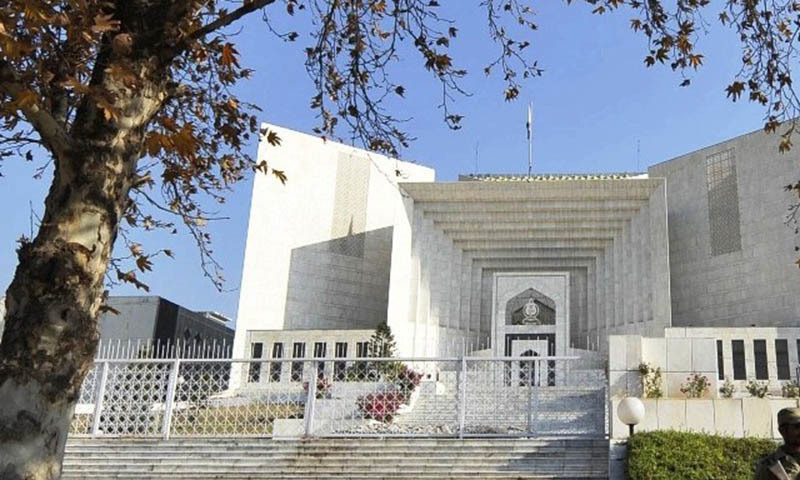
The Supreme Court has directed accountability courts to refrain from delivering final judgments in corruption cases, following a pivotal hearing today on the intra-court appeals (ICAs) against the September 15 majority judgment, which invalidated amendments to the accountability law.
The court adjourned the hearing until the detailed verdict on the law curbing the chief justice’s powers is issued. Chaired by Chief Justice of Pakistan (CJP) Qazi Faez Isa, the larger bench, which also comprised Justice Aminuddin Khan, Justice Jamal Khan Mandokhail, Justice Athar Minallah, and Justice Syed Hasan Azhar Rizvi, deliberated two ICAs filed by the federal government and former SSGCL managing director Zuhair Ahmed Siddiqui.
The hearing adhered to the October 11 short order affirming the Supreme Court (Practice and Procedure) Act 2023, established by the PDM government to regulate the affairs of the top court.
Consequently, the Supreme Court issued a circular on October 26, indicating that any appeal against decisions under Article 184(3) of the Constitution should be filed as an ICA, in accordance with Section 5 of the aforementioned Act.
During today’s hearing, the federal government, in an application dated October 30, requested an adjournment until the week of November 6 due to the unavailability of its counsel, Makhdoom Ali Khan, who was abroad.
Attorney General for Pakistan (AGP) Mansoor Usman Awan appeared as the federal government’s counsel, while Farook H. Naek represented Siddiqui.
Naek urged the court to suspend the verdict on the accountability law amendments, a plea that was ultimately denied. Given the pending release of the detailed verdict on the law curtailing the CJP’s powers, the court deferred the proceedings accordingly.
In the midst of the hearing, CJP Isa acknowledged other pending applications, initiating a series of exchanges between the court and the counsels. The court emphasized the need to await the detailed verdict, which would provide crucial insights into the legal nuances of the case.
However, Naek expressed concern over the potential delay in proceedings and urged the court to proceed promptly. The court acknowledged the complexities and intricacies of the case, emphasizing the importance of adhering to due process and ensuring fair trials in all legal proceedings.
With the Supreme Court’s decision to await the detailed judgment on the Practice and Procedures Act, the legal community anticipates the comprehensive guidance that will emerge from the forthcoming verdict, offering a critical interpretation of the contentious legal provisions.