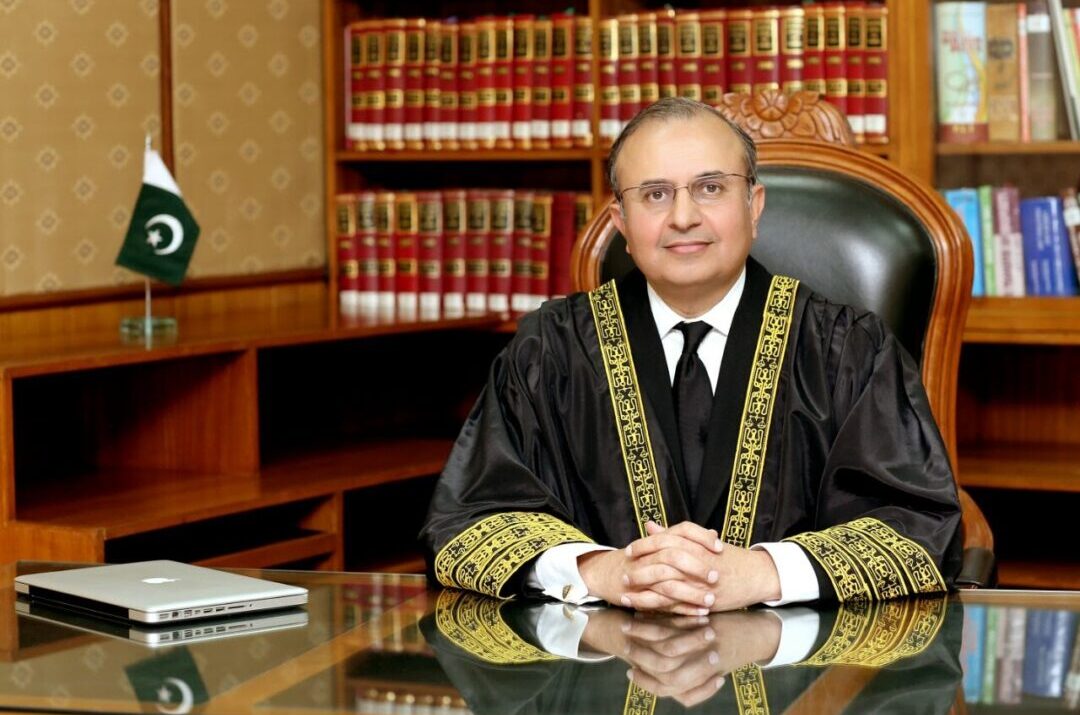
In response to the National Accountability Ordinance (NAO) amendments, Supreme Court Justice Mansoor Ali Shah presented a comprehensive 27-page dissenting statement on the verdict. Notably, he emphasized the importance of accountability for all, including members of the armed forces and judges, under the purview of accountability laws.
The apex court, in a majority 2-1 decision on September 15, revoked certain alterations made to the NAO, 1999 during the previous tenure of the Pakistan Democratic Movement (PDM)-led government. The three-member bench, headed by former Chief Justice Umar Ata Bandial, also comprised Justice Mansoor Ali Shah and Justice Ijaz Ul Ahsan.
Justice Shah’s dissenting note, issued today, highlighted that the judges of the constitutional court and the members of the armed forces should be subject to the NAB Ordinance like any other public servant of Pakistan. He emphasized the need for the courts to uphold the principle of the “trichotomy of power,” ensuring no organ of the state claims superiority over the others.
Underscoring the judiciary’s responsibility to adhere to the law and the Constitution regardless of public sentiment, Justice Shah emphasized the importance of maintaining the independence of all state pillars within their respective spheres. He stressed that no organ should encroach upon the functions of another.
Regarding the impact of the amendments on fundamental rights, Justice Shah addressed objections raised by PTI chief Imran Khan, emphasizing that the amendments did not infringe upon the fundamental rights of citizens as guaranteed by the Constitution. He highlighted that the changes in the NAB Ordinance merely adjusted the forums for the investigation and trial of corruption cases involving amounts or properties below Rs500 million.
According to Justice Shah, these matters fall within the exclusive domain of the legislature and are not subject to judicial review. He maintained that the amendments did not curtail any fundamental rights guaranteed to the people of Pakistan.
Overall, Justice Shah’s dissenting note emphasized the necessity of upholding the separation of powers and ensuring the accountability of all individuals, including those within powerful institutions, under the established laws of the country.