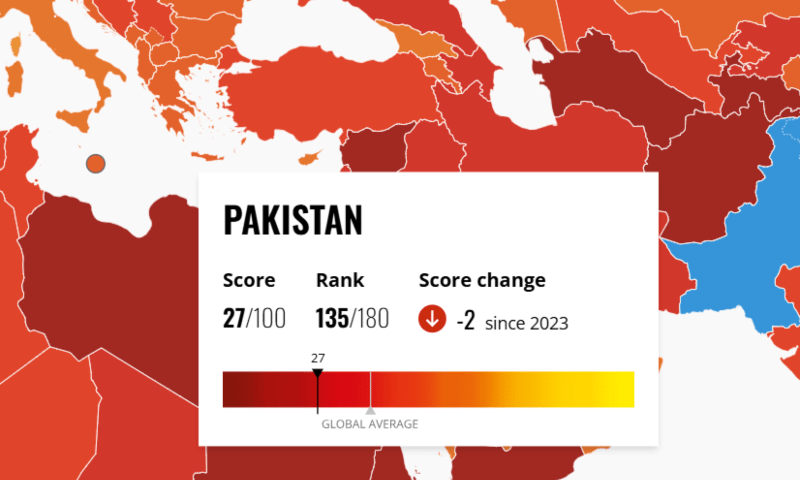
Pakistan’s ranking on the Corruption Perception Index (CPI) 2024 has slipped two spots, falling from 133rd in 2023 to 135th in 2024 out of 180 countries, according to Transparency International’s latest report released on Tuesday.
The CPI measures public sector corruption perception on a scale from zero (highly corrupt) to 100 (very clean). Pakistan’s score also declined, dropping from 29 in CPI 2023 to 27 in CPI 2024, indicating worsening corruption levels. The country’s score over the past decade has fluctuated between 27 and 33, with the highest recorded at 33 in 2018 before declining consecutively.
According to Transparency International Pakistan (TIP), the organization has no role in data collection or calculation of scores. Historical statistics reveal that Pakistan ranked second-last in 1996 among 54 countries, scoring just 1/10. Between 1997 and 2011, the country’s score fluctuated, peaking at 2.7 in 1998 and dropping as low as 2.1 in 2004 and 2005. Since the index transitioned to a 100-point scale in 2012, Pakistan’s performance initially improved but later deteriorated to its current score of 27.
Transparency International Pakistan’s chair, retired Justice Zia Perwez, noted that most regional countries, except Oman, China, Turkiye, and Mongolia, witnessed a decline in CPI scores, emphasizing that Pakistan remains among those resisting a more drastic regional downward trend.
Transparency International’s report highlights a global stagnation in anti-corruption efforts. Over two-thirds of the countries assessed scored below 50, indicating widespread corruption. The report warns that approximately 6.8 billion people—85% of the world’s population—live in nations where corruption is prevalent.
For the seventh consecutive year, Denmark topped the CPI with a score of 90, followed by Finland (88) and Singapore (84). Conversely, countries with the lowest rankings included South Sudan (8), Somalia (9), Venezuela (10), Syria (12), and Libya (13), among others.
In the Asia-Pacific region, Transparency International observed a concerning downward trend due to corruption cycles and climate change challenges. The Middle East and North Africa showed minor improvement, increasing by just one point to 39 after over a decade of stagnation.
The CPI report underscores the link between corruption and climate change, warning that the misappropriation of climate funds and weakened governance structures hinder effective climate action. Transparency International Chair Francois Valerian stressed that corruption fuels instability, weakens democracy, and undermines global sustainability efforts.
Transparency International CEO Maíra Martini echoed these concerns, stating that corrupt forces influence policies and suppress accountability measures, jeopardizing billions of dollars meant for climate resilience projects. Many of the nations most vulnerable to climate change score below 50 on the CPI, putting millions at risk due to corruption’s interference in climate initiatives.
The CPI 2024 report emphasizes the urgent need for global anti-corruption measures to ensure transparency, accountability, and robust governance. Without decisive action, corruption will continue to undermine climate policies, economic growth, and human rights worldwide. Transparency International has urged governments to prioritize anti-corruption reforms to safeguard financial resources and foster sustainable development.