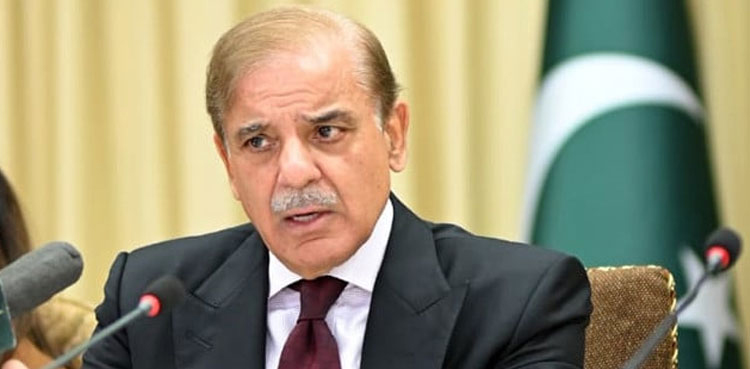
Prime Minister Shehbaz Sharif has embarked on his first official five-day visit to China since assuming office in March this year. The visit aims to strengthen bilateral trade and economic relations with Beijing and attract Chinese investment in Pakistan through business-to-business (B2B) projects.
The premier’s visit follows an invitation from Chinese President Xi Jinping and Premier Li Qiang. During the trip, PM Shehbaz will visit Beijing, Xi’an, and Shenzhen. In Beijing, he will hold high-level meetings with President Xi Jinping and conduct delegation-level talks with Premier Li Qiang.
This visit comes more than a month after Pakistan arrested four terrorists involved in a deadly explosion targeting a car carrying five Chinese citizens on March 26. The focus of the trip includes enhancing economic cooperation and addressing security concerns.
In addition to his meetings with President Xi Jinping and Premier Li Qiang, PM Shehbaz will meet with Zhao Leji, Chairman of the Standing Committee of the National People’s Congress, and heads of key government departments.
To further economic ties, the prime minister will engage with corporate executives from leading Chinese companies in sectors such as oil and gas, energy, ICT, and emerging technologies. In Shenzhen, he will address the China-Pakistan Business Forum, engaging with businesspersons, entrepreneurs, and investors from both countries. He will also visit Economic and Agricultural Zones in China.
Discussions during the visit will focus on upgrading the China-Pakistan Economic Corridor (CPEC) and advancing trade and investment. The talks will cover cooperation in security and defense, energy, space, science and technology, and education.
An official told The News that various memorandums of understanding (MoUs) and agreements are expected to be signed during the prime minister’s visit. One significant topic will be extending the repayment tenor of outstanding loans from Chinese Independent Power Producers (IPPs) by five years to reduce electricity costs.
The visit is also expected to advance the second phase of the China-Pakistan Economic Corridor (CPEC) and progress on the Mainline-1 (ML-1) railway project. Pakistan has already approved the PC-1 of ML-1 with an estimated cost of $6.7 billion, to be executed in two phases. Given the limitations under the International Monetary Fund (IMF) program on sovereign guarantees, the government may request China to accomplish the ML-1 project in more than two phases.
Federal Minister for Planning Ahsan Iqbal confirmed that ML-1 is a top priority for the government and expressed optimism about substantial progress during the visit.