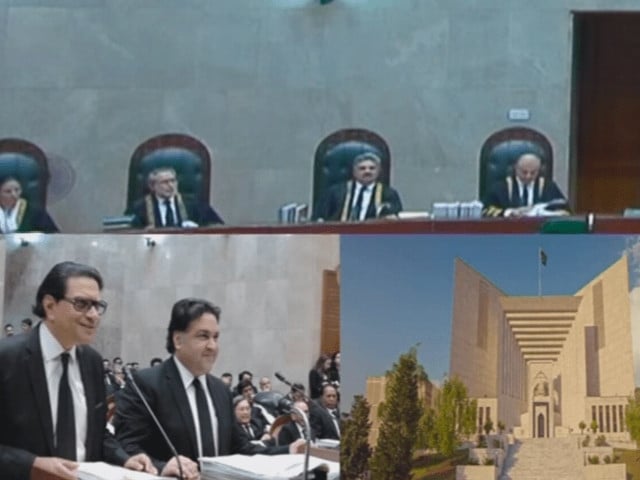
Chief Justice of Pakistan (CJP) Qazi Faez Isa remarked on Tuesday that numerous issues could have been avoided if the Pakistan Tehreek-e-Insaf (PTI) had conducted intra-party elections.
This statement was made during a hearing on the Sunni Ittehad Council’s (SIC) petition against the denial of reserved seats for women and minorities.
The full court bench, consisting of 13 members and led by CJP Isa, includes Justices Syed Mansoor Ali Shah, Munib Akhtar, Yahya Afridi, Aminuddin Khan, Jamal Khan Mandokhail, Muhammad Ali Mazhar, Ayesha Malik, Athar Minallah, Syed Hasan Azhar Rizvi, Shahid Waheed, Irfan Saadat Khan, and Naeem Akhtar Afghan.
Ahead of the February 8 elections, the PTI had allied with the SIC after the Election Commission of Pakistan (ECP) stripped the PTI of its electoral symbol, a decision upheld by the Supreme Court. Despite this alliance, the ECP did not allocate reserved seats to the SIC, citing the party’s failure to submit a list of candidates. The SIC subsequently appealed to the Peshawar High Court, which upheld the ECP’s decision.
In April, SIC chief Sahibzada Hamid Raza, along with the Khyber Pakhtunkhwa Assembly speaker, petitioned the Supreme Court to overturn the Peshawar High Court’s verdict and allocate 67 women and 11 minority seats in the assemblies. A three-member Supreme Court bench suspended the High Court’s decision and referred the matter to a larger bench for constitutional interpretation.
Today’s Hearing
During today’s hearing, SIC’s lawyer Advocate Faisal Siddiqui argued that the SIC did submit a candidate list, but the ECP rejected it because the party did not contest the elections as a party. CJP Isa noted that the SIC had presented itself as both a parliamentary political party and a political party on different occasions.
Advocate Siddiqui contended that the Constitution allows for a political party to also be a parliamentary political party. The chief justice pointed out that the Constitution differentiates between the two. The SIC lawyer maintained that the Constitution does not specifically mention “parliamentary party” except in Article 63A.
When Advocate Siddiqui suggested that the Supreme Court’s verdict on the bat symbol could have clarified matters, CJP Isa emphasized that the issue of reserved seats would not have arisen if the PTI had held intra-party polls. He stated, “Don’t blame everything on the SC.”
Justice Akhtar recalled that independent candidates had identified themselves as affiliated with the PTI and had their nomination papers accepted, even winning the polls. He noted that a candidate who presents themselves as belonging to a party will be considered affiliated with it unless they submit an affidavit stating otherwise.
The chief justice questioned why the PTI did not challenge the court’s orders regarding the bat symbol. He asked why the PTI’s independent candidates did not request the bat symbol, suggesting that the party should have at least attempted to secure it.
The court adjourned the hearing until June 24.