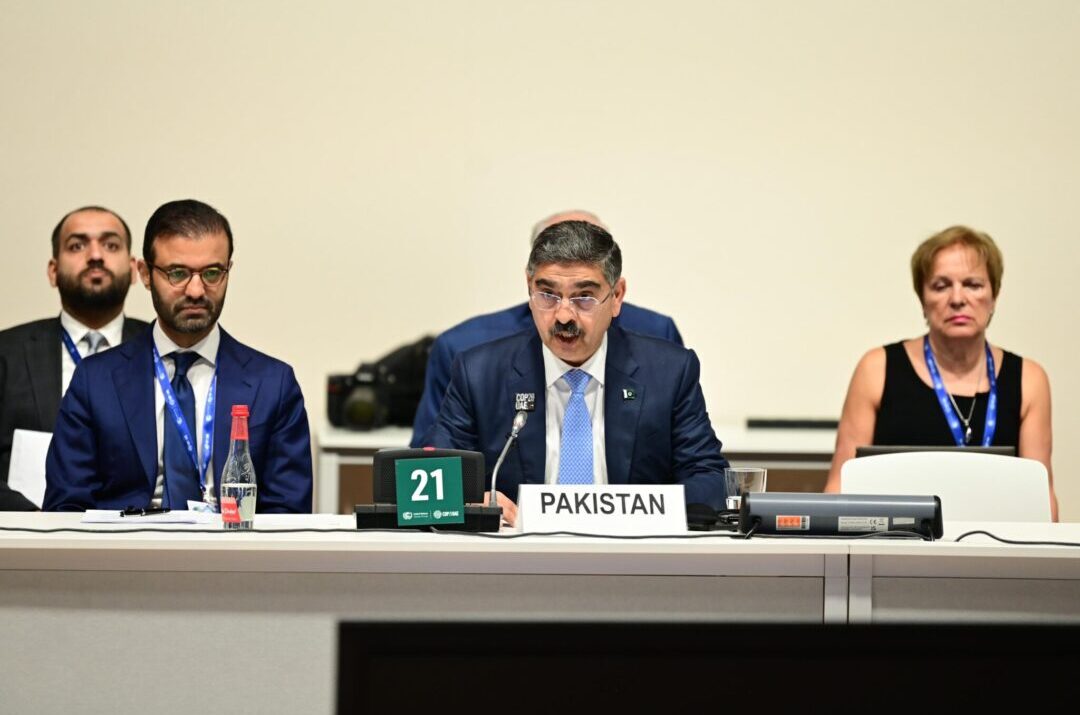
Caretaker Prime Minister Anwaar-ul-Haq Kakar emphasized the necessity of meeting the growing needs of developing countries to implement climate change actions. In his address to the Global Stock Take (GST) event on means of implementation, he stated, “Financial needs of the developing countries are way more than the unfulfilled US$100 billion pledge.”
He highlighted that even to fulfill less than half of their existing Nationally Determined Contributions (NDC), developing countries needed $6 trillion by 2030. The prime minister pointed out that adaptation needs alone were $387 billion per year till 2030, and estimates for loss and damage were around $400 billion annually, expected to grow to $1 to 2 trillion by 2050.
He urged that the outcomes of GST and COP28 must highlight the enormous gap between the finance mobilized and the needs of developing countries. The prime minister also called upon developed countries to urgently rectify shortfalls in their finance commitments under the Paris Agreement, unlocking scaled-up and improved financial support to enable developing countries to bridge the implementation gaps in their mitigation and adaptation actions.
“We believe outcomes of the GST are well-timed to guide the critical discussion in 2024 on setting post-2025 new collective quantified goals on finance commensurate with the needs of developing countries,” he remarked. He also stressed that the GST should strengthen the effectiveness of the technology mechanism in scaling up the development and transfer of proven climate technologies and enable a better degree of capacity building for developing countries.
“The need for reform of the international financial architecture also requires focus,” he added. Regarding technology transfer, PM Kakar said, “We propose to focus on key and high-emitting sectors with joint indicators, functioning solutions, time frames, and enabling conditions needed to put in place green technologies.”
On capacity building, he said developing countries required support and greater coherence and coordination across the UN system. “To attract the required private and public investment, developing countries must be provided capacity-building support to develop appropriate instruments and create pipelines of bankable projects for adaptation and mitigation,” he remarked.
He hoped that discussions and deliberations here and throughout the COP could result in ambitious outcomes on the means of implementation that are equitable and responsive to the needs of developing countries. He said, “We have all come here with one aim: ensuring that the planet remains livable for our children and children’s children.” “Our assembly here recognizes the acuteness of challenges faced in the realm of climate extremes. The notion of implementation and support is a critical element of the Global Stock Take report,” he added. The prime minister maintained that climate change was happening now, with some witnessing it on television screens, while others, like people in Pakistan, were witnessing it first-hand. “The critical concern for developing countries like Pakistan is the recurring natural disasters and consequent adaptation needs in the impacted sectors of water, agriculture, urban resilience, natural capital, and human health,” he said.