The Senate Standing Committee on Cabinet Secretariat has taken a significant step by summoning the Ministry of Foreign Affairs and the Attorney General for Pakistan (AGP) to elucidate the reported objections raised by the United States regarding the multi-billion-dollar Iran-Pakistan (IP) gas pipeline project.
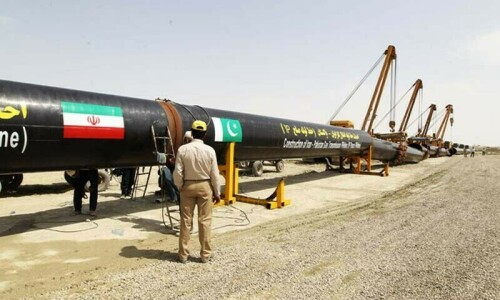
Tehran has claimed to have completed its side of the 1,150-kilometer pipeline, initially estimated at $7.5 billion, with a groundbreaking ceremony held in March 2013. Pakistan had committed to finishing its side of the project by January 2015. However, international sanctions on Iran led to a halt in progress, and in February 2014, the then petroleum minister declared the project “off the table.”
Earlier this year, former petroleum minister Musadik Malik explained that despite Pakistan’s commitment to its contractual obligations, US sanctions on Iran had prevented the commencement of pipeline construction. Pakistan had sought a resolution from Washington to address energy shortages but had not yet received a response.
In August, Pakistan issued a ‘Force Majeure and Excusing Event’ notice to Iran, effectively suspending its contractual obligation on the gas pipeline. This suspension is contingent on US sanctions on Iran remaining in place or Washington permitting Pakistan to proceed with the project.
During a recent Senate panel discussion, Petroleum Additional Secretary Hassan Yousafzai revealed that Iran had set a 2024 deadline for pipeline completion, with potential fines for failure to meet it. Efforts are underway to renegotiate the project with Iran, exploring alternative ways to secure gas supplies.
Yousafzai expressed concerns about potential liabilities amounting to $20 billion and stated that the issue had been raised with the US. He also noted that the cost of laying the gas pipeline to Gwadar would be $2 billion, while reneging on the deal with Iran could result in an $18 billion penalty.
Senator Mushtaq Ahmed called for the Ministry of Foreign Affairs to be summoned to investigate why Pakistan could not procure affordable gas from its neighboring country. The committee chairperson, Sadia Abbasi, questioned how the agreement was signed amid such restrictions and noted that India had not faced similar challenges.
PPP Senator Waqar Mehdi clarified that the agreement was signed during the tenure of ex-president Asif Ali Zardari.
The Iran-Pakistan gas pipeline project was intended to supply 750 million cubic feet per day (MMCFD) of gas but faced opposition from the US authorities, despite framework agreements and a Gas Sales and Purchase Agreement (GSPA) signed in 2009 and 2010. Pakistan, in 2014, agreed to the pipeline with a condition stipulating significant penalties if the project were abandoned.