Doctors disseminate information among citizens on antimicrobial resistance
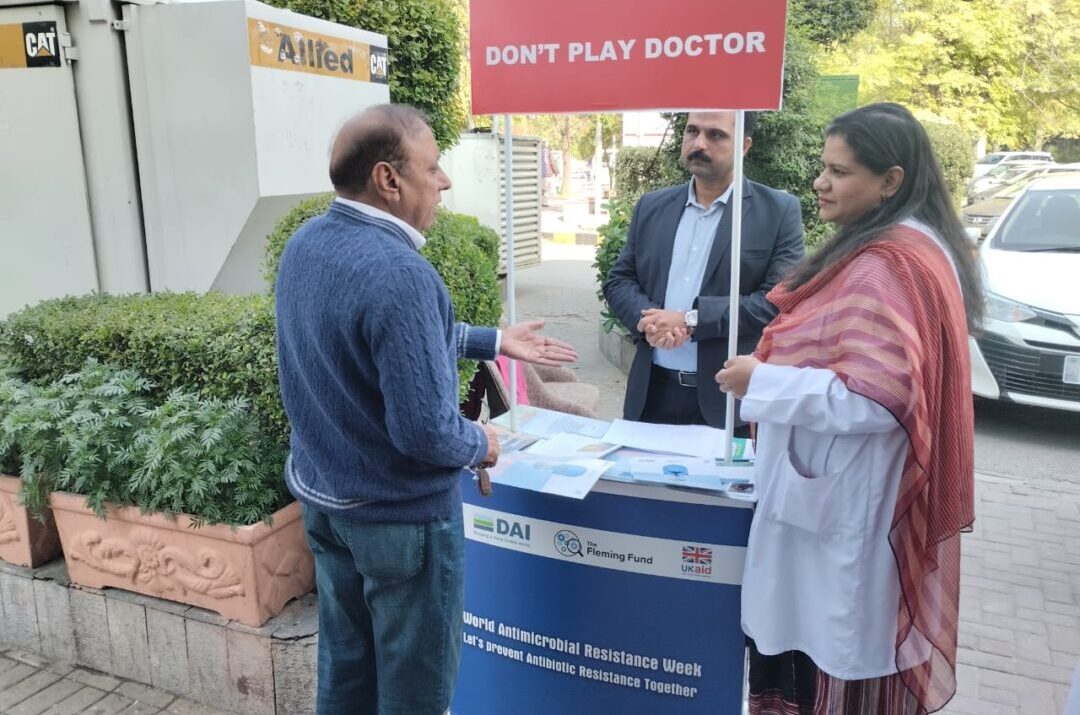
Citizens were given useful and critical information about the misuse of antibiotics on Tuesday and how can this give rise to the public health threat of antimicrobial resistance (AMR) in Pakistan.
A group of doctors and pharmacists provided this information in Islamabad’s F-6 Markaz at an awareness kiosk established by the DAI-Fleming Fund Country Grant Pakistan. This daylong kiosk was part of the World AMR Awareness Week (WAAW), an annual event held from November 18 to 24.
“It’s a silent pandemic which everybody needs to know about,” said Dr Qadeer Ahsan, Team Lead DAI-Fleming Fund Country Grant Pakistan. “It is critical for people to understand that antibiotics are needed only for treating severe bacterial infections. Antibiotics do not work on viruses.”
The health professionals at the kiosk informed the citizens about the negative effects of antimicrobial resistance on humans, animals, and environment. Apart from highlighting the dangers of self-medication for one’s health, they distributed flyers on what are antibiotics, what is AMR, and how it damages the health of humans and animals.
Pakistan is the third largest consumer of antibiotics in low to middle-income countries, according to Dr Tauqeer Mustafa of the Fleming Fund. “Half of these antibiotics are inappropriately prescribed,” he added.
World AMR Awareness Week is a global campaign that is celebrated annually to improve awareness and understanding of AMR and encourage best practices among the public, One Health stakeholders and policymakers, who all play a critical role in reducing the further emergence and spread of AMR.
The Fleming Fund is a UK-funded program that focuses on controlling antimicrobial resistance (AMR) and is currently being implemented in more than 25 countries across Africa and Asia, managed by the UK Department of Health and Social Care (DHSC). Started in 2019, the Fleming Fund Country Grant Pakistan (FFCGP) aims to address critical gaps in the surveillance of AMR and represents the UK Government’s investment into improving laboratory capacity for diagnosis and surveillance of anti-microbial resistance (AMR).
Mott MacDonald, the global AMR management agent has appointed Development Alternatives Incorporation (DAI) as the lead grantee to deliver the Country Grant in Pakistan. DAI along with its consortium partners Liverpool School of Tropical Medicine (LSTM), Health Security Partner (HSP) and Indus Hospital & Health Network (IHNN) manages this grant in the country.
What is antimicrobial resistance?
Antimicrobial resistance (AMR) occurs when bacteria, viruses, fungi, and parasites change over time and no longer respond to medicines, making infections harder to treat and increasing the risk of disease spread, severe illness and death. As a result of drug resistance, antibiotics and other antimicrobial medicines become ineffective and infections become increasingly difficult or impossible to treat.